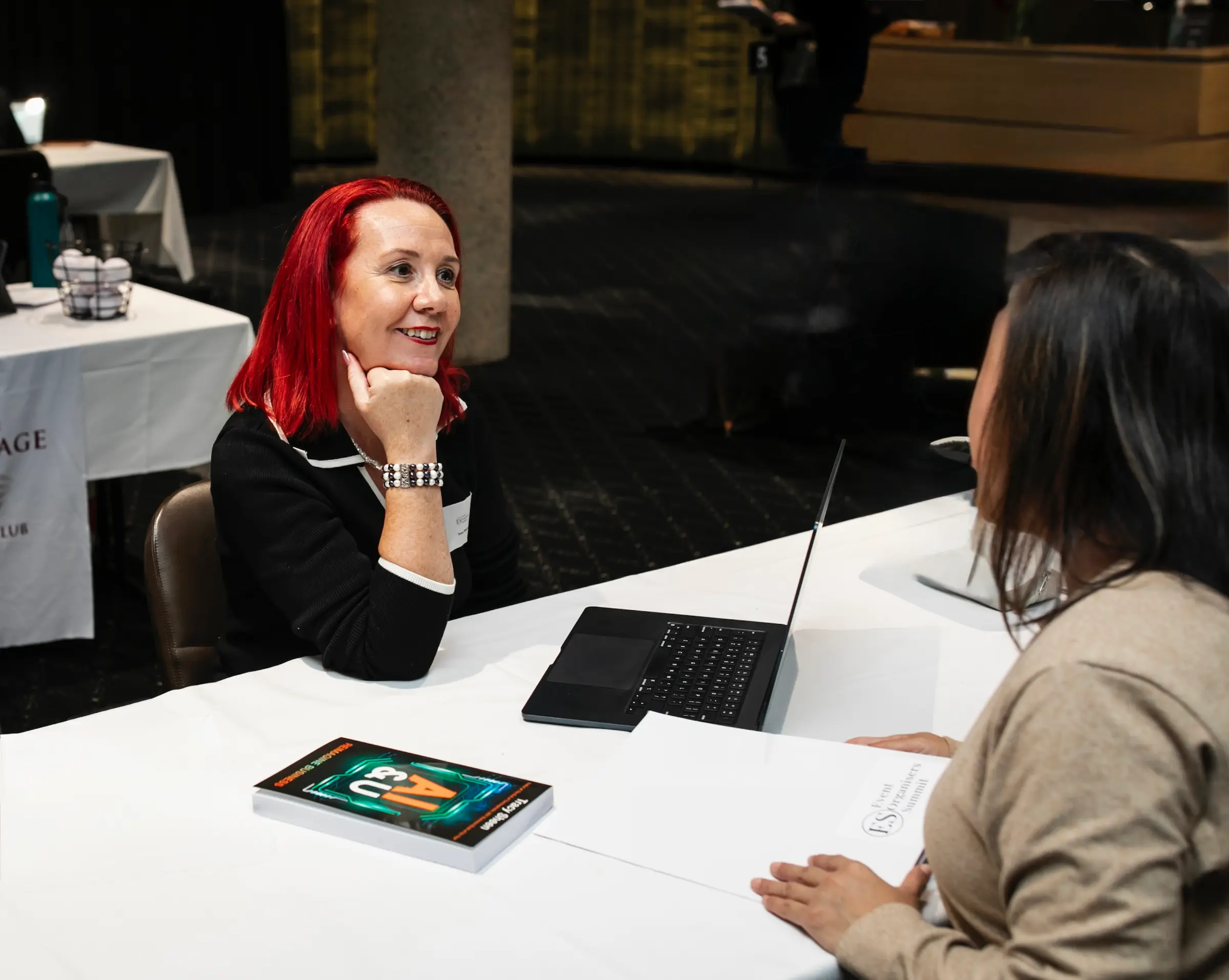
An AI coach builds your personal capability: your prompting, your habits, your confidence with the tools. An AI advisor builds your organisation’s capability: the guardrails, the strategy and the training that sticks across a whole team. Both are legitimate. They solve different problems. And most businesses searching for an AI business coach are shopping for the second one without knowing the word for it.
What does an AI coach actually do?
Good coaching is personal. A coach works with you, one on one or in a small group, on the skills that make AI useful in your own hands: how to ask well, how to judge the output, how to build the daily habit rather than the occasional experiment.
Who should hire one? Solopreneurs. Career changers. A leader who wants personal fluency before leading anyone else through change. Plenty of coaching is self-directed and modestly priced, and for individual capability it works. If the problem lives inside your own working week, a coach is the right call and there are good ones about.
What does an AI advisor do?
Advisory work starts one level up. Not how do I use this tool, but where does AI belong in this business, who decides, who checks and who answers when it goes wrong. An advisor assesses where AI creates real value across the organisation, designs the guardrails and builds the capability of the team rather than one person.
The market data agrees. Global spending on AI consulting passed USD $29 billion in 2025, yet 72% of enterprise AI projects still fail at deployment. Tool access is not the bottleneck. Organisational thinking is. That’s advisor territory, and it’s the work my GIST framework was built for: Guardrails, Intent, Strategy, Practical Training, in that order.
It’s the difference between teaching one person to swim and deciding where the flags go for everyone. I’ve done this work with regional programswhere the brief was never one person’s skills. It was a whole community of businesses moving safely at once.
Three questions that sort it
- One. Am I trying to build my own skills, or change how my organisation works?
- Two. Do I want someone to walk me through the tools, or someone to say which tools we adopt and what rules sit around them?
- Three. Is the problem individual capability, or organisational strategy?
If your answers keep landing on the second half, you’re advisor shopping. You just typed coach into the search bar because it’s the word everyone knows.
What does working with an advisor look like?
Shapes vary across the industry, but good advisory work follows an arc: an honest look at where you are, a plan, a build, then support while it beds in.
In my practice that starts with a Reconnaissance day: one day inside your business, leadership in the room and a straight read on where AI fits and where it doesn’t. No slideware, no pre-cooked answer. From there the work moves to per-role planning, the first build and ongoing advisory while your team finds its feet. Organisations of roughly 30 to 300 people are where I do my best work. Bigger than that and I’ll happily point you to the right people, because an advisor who takes every job isn’t advising, they’re billing.
If that sounds like the conversation you’ve been circling, that’s what Work with Me is for.
What to do on Monday morning
- Write the problem in one sentence. If it starts with I want to get better at, you’re after a coach. If it starts with we need to, you’re after an advisor.
- Ask whoever you’re considering, coach or advisor, one question: how will we know this worked? Vague answers now become vague outcomes later.
- Have the conversation before you have the budget meeting. Twenty minutes of honest scoping saves months of the wrong engagement. Mine starts here.
Twenty minutes of honest scoping.
An honest look at where you are, a plan, a build, then support while it beds in. Have the conversation before you have the budget meeting.
Work with me →Questions people ask
What does an AI advisor cost in Australia?
It scales with scope. Single-day assessments generally sit in the low to mid thousands; ongoing advisory runs as a monthly retainer, usually over six months or more. Be wary of anyone quoting a flat price before asking about your business. That's answering the wrong question first.
What is the difference between an AI coach and an AI consultant?
Consultant and advisor cover the same territory: organisational work. Coach is personal work. Titles drift across the industry, so use the test instead of the title: does the engagement change you, or change the business?
How do I know my business is ready for an advisor?
Three signs. You have more than a handful of staff. AI decisions now touch clients, money or compliance. And the leadership question has moved from should we to how do we do this safely. If you're a team of one, build your own fluency first; that's coach territory, and the practical end of my work will serve you better than a boardroom engagement.
What should I prepare before a first conversation?
One page. What you sell, how many people you have, which AI tools are already in use (declared or not, because your people are already using AI) and the one decision you're stuck on. That page turns a get-to-know-you call into a working session.
Human-led. AI-leveraged. My philosophy, my business, this article. The Augmented Workforce in action.
Drafted with Ada, my AI collaborator. Reviewed, shaped and signed off by me. How I work with AI· Tracy Sheen CSP