Case Study · Chamber of Commerce · QLD · AI Workshops for Small Business
How 39 Chinchilla business people put AI to work on the job that eats their week.
19 November 2026Chinchilla RSL, Chinchilla QLDTwo three hour workshopsBusiness Focus Session
39 in the room
across a morning and an afternoon session at Chinchilla RSL
4.7 out of 5
for how likely they were to recommend it to another business owner*
48 hours a week
the least 29 people expect AI to give them back between them, by their own estimate*
*Slido live polls in both rooms, 19 November 2026. 31 answers on recommending it, 29 on time saved.
In short
On Thursday 19 November 2026, Tracy Sheen ran two three hour AI workshops for 39 small business people at Chinchilla RSL, as a Business Focus Session for the Chinchilla Chamber. The content was built from a form the room filled in before the day. Both rooms named email as the job that eats their week. Three local businesses went up on the big screen. The rooms scored it 4.7 out of 5 for would recommend, and between them they expect AI to give back at least 48 hours a week.
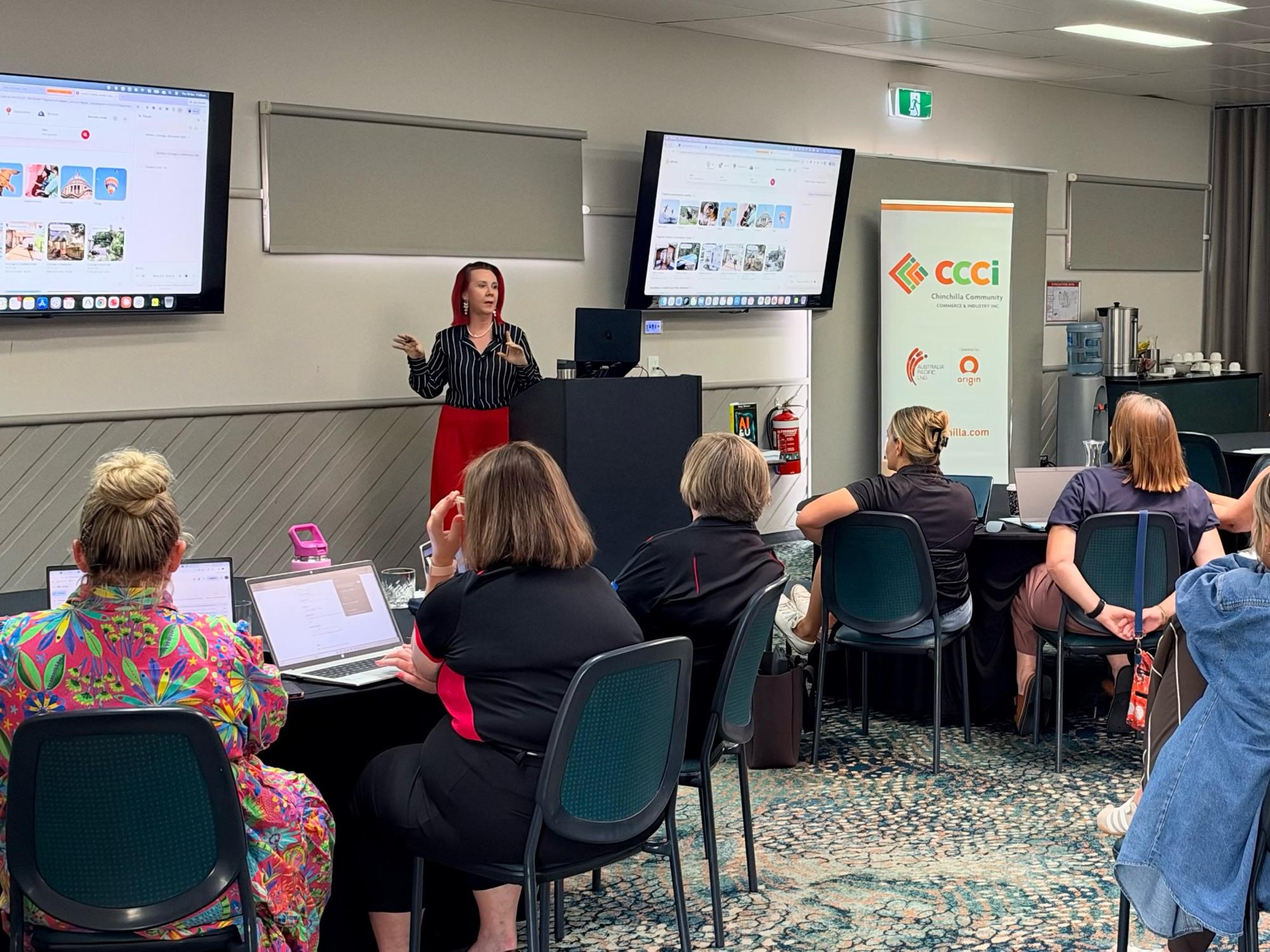
The client
Chinchilla Chamber’s Business Focus Session, Chinchilla QLD
Business Focus Sessions exist to connect Chinchilla’s local businesses and build them up. This one, Unlock the Power of AI, was presented by CCCI (opens in a new tab), the Chinchilla Chamber of Commerce and Industry, and proudly supported by QGC and EnVision Partners (opens in a new tab).
It ran twice on Thursday 19 November 2026 at Chinchilla RSL, 9am to 12pm and 2pm to 5pm. Fifty-six tickets went out. Thirty-nine people came, two of them walk-ins.
They were graziers and cattle producers, transport operators, engineers, electrical and plumbing businesses, a cleaner, an agronomist, a drone operator, a lawyer, a rural charity and an online retailer selling to the world from the Western Downs. Plenty of them wear every hat in the place: owner, admin, accounts and HR.
The challenge
Already using AI. Not sure they were doing it right.
This was not a room of beginners. About nine in ten had used an AI tool in the last month. The morning room leaned on ChatGPT. The afternoon room leaned on Copilot.
Morning roomAfternoon room
ChatGPT
71%
53%
Copilot
24%
60%
Claude
43%
20%
Gemini
19%
27%
None yet
10%
13%
Confidence was another story. Asked to rate themselves out of 5 on the way in, the two rooms averaged 2.5, and 14 of the 31 who answered gave themselves a one or a two. They had the tools. What they wanted was to know they were using them properly.
Before the day
The room wrote the brief.
There was no off-the-shelf deck for this one. Before the workshop even started, a short Google form went out so people could share their answers and ideas for the session. What do you do? Which AI tools do you use now? What is one job you would love AI to take off your plate?
Nineteen people answered, and their answers became the content. The tools they named decided which three the session covered: Claude, ChatGPT and Copilot. The jobs they named became the demos in the deck and the prompts on the take-home page. Writing quotes. The weekly lookahead. Procedures. Checking a supplier statement against the invoices. Commentary for the monthly reports. And the inbox, over and over.
Then, on the day, both rooms were asked the same thing. In two words, what is one job that eats your week?
- Managing emails
- Phone calls
- Weekly reports
- Pricing and quotes
- Reconciling Xero
- Daily reports
- Grazing plan
- Procedures
- Compliance management
- Inventory management
- Marketing
- Travel
What we did
A three hour AI workshop, run twice.
Six parts, in plain language. Foundations. What AI is good at. What it is still rubbish at. How to ask. Let’s go live. Make it stick.
Guardrails came before a single prompt. What never goes into a free AI tool: client details, tax file and bank numbers, passwords, staff records, health information. Tracy’s GIST framework sits under all of it, and one rule got repeated all day. AI drafts. Humans check.
Everyone left with a take-home page built for these two rooms. Sixteen copy and paste prompts for small business, matched to the jobs they named. The basics of Claude, ChatGPT and Copilot side by side. And the rules that keep a small business out of strife.
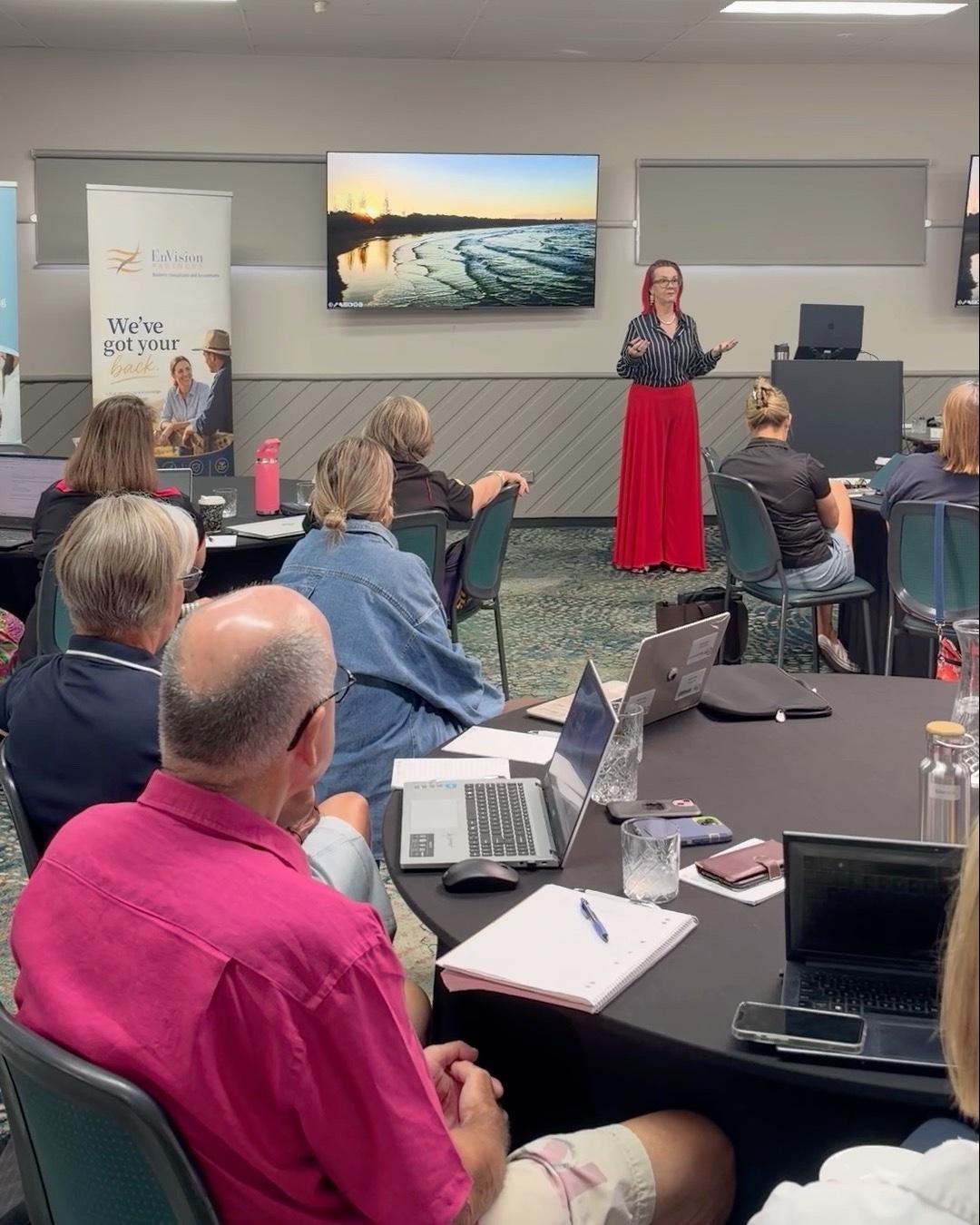
Live demos
Three local businesses, live on the big screen.
Part five is called Let’s go live, and it means it. Three local business owners put their hand up. Each time, Claude drove the browser on the big screen and the method stayed the same. Give it a role. Point it at the real page. Then keep asking questions.
Switch’D Electrical: built the house, forgot the letterbox
The brief to Claude: act as a website strategist for the electrical industry and tell us how this business is being found. It read the Switch’D (opens in a new tab) website and the code behind it, ran six live searches and mapped who turns up for electrical, air conditioning and solar work around Chinchilla.
The website itself was in good shape. Service pages, town pages, an FAQ. It even has the file that invites ChatGPT, Claude and Perplexity in. Then Claude searched the business name and got chinchillas. The furry kind.
Tracy’s summary for the room: built the house, forgot the letterbox. The Monday jobs were reviews, directory listings and a main heading with the words people search for. And one line every business in the room could take home. Your website is the shopfront. Reviews and listings are the signage.
Settler’s Cottage: a cracking Airbnb listing nobody was searching for
Helen’s farm stay near Drillham has 4.98 stars from 42 reviews on Airbnb (opens in a new tab), plus Guest Favourite and Superhost badges. It still was not being found. So Claude became her Airbnb specialist and went looking for why.
Airbnb search follows the map, and nobody types Glenaubyn. They search Miles or Roma. No wifi and no air conditioning also knock the cottage out of filtered searches before anyone lays eyes on it. Tracy kept at it. What are we missing? What would make the most difference? What would you fix first? Claude listed what it could not see, like Helen’s own booking dashboard, then put the jobs in order. Get into more searches. Then price. Then title and photos.
A few minutes later the same listing link went into a second chat with one instruction: create a website to support the property. Back came a one page site built from the listing’s own photos. No made-up reviews. No made-up prices. By the next day, the listing’s title had Miles in it.
Lapunyah Art Gallery: give the machines something to quote
The afternoon belonged to the gallery. Claude went through the Lapunyah Art Gallery (opens in a new tab) homepage and six more pages as a strategist in the art world. The art was all there. The answers to what visitors ask were not: opening hours, cost, how to exhibit. If it is not written down in plain text, Google and the AI tools have nothing to quote.
The gallery left with five jobs for Monday morning, starting with a new homepage title. And one idea worth more than all five. Artist stories sell art.
Every demo ended with what to do on Monday morning, in jobs the owner can do themselves. And every time, Claude said what it could not see. No Search Console. No host dashboard. Seven pages, not the whole site. Humans lead. AI does the rest.
Time back
48 hours a week.
That is the least the two rooms expect AI to give them back, between 29 people. More than a full-time working week, every week.
Both rooms were asked how much time AI could save them each week. Most said one to three hours. In the afternoon room, every one of the 15 who answered said at least an hour. Count each person once, at the bottom of the range they chose, and it comes to 48 hours a week. These are their own estimates on the day, before anyone had tried a thing.
Under an hour
5
1 to 3 hours
15
3 to 5 hours
6
5 hours or more
4
Results
What the two rooms said on the way out.
Both rooms rated their own confidence with AI at the start and again at the end. Walking in, the average was 2.5 out of 5, and 14 people gave themselves a one or a two. Walking out, the average was 3.7. Nobody gave themselves a one and only one person gave themselves a two. These are self-ratings on the day, before anyone had tried a thing on Monday.
Walking inWalking out
1
2
3
4
5
One cattle producer walked in rating himself a one, or lower. He walked out at a three, already thinking through the ways he could put it to use.
25 gave it five out of five
4 gave it four
2 gave it three
Asked how likely they were to recommend the session to another business owner, the two rooms scored it 4.7 out of 5. Asked how useful it was for their own business, 4.3 out of 5 from 30 answers.
And two businesses from the room have already asked Tracy to hold dates of their own.
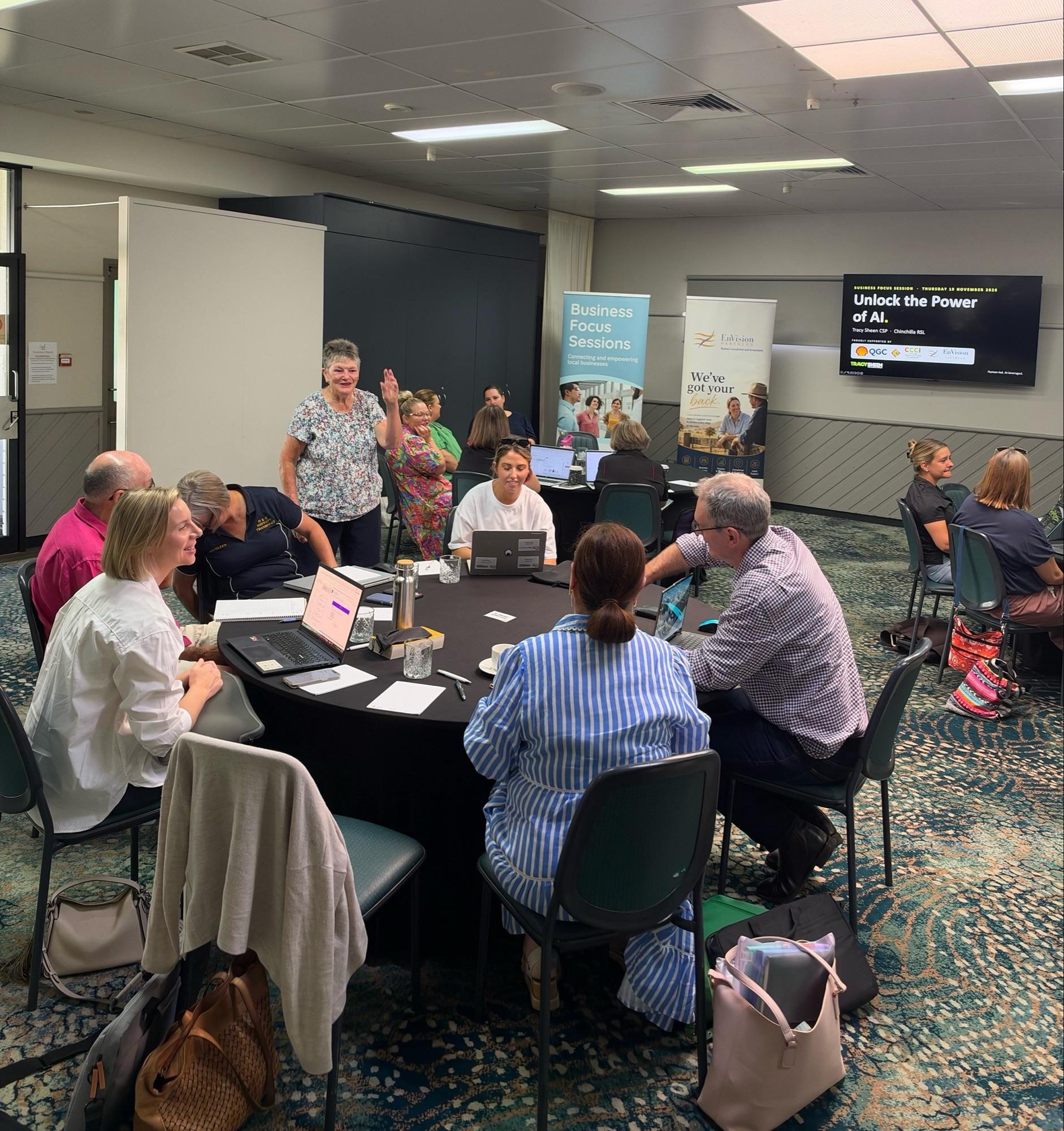
What happens Monday
One job each for Monday morning.
The last question in each room: what is the one thing you are trying on Monday? The inbox won again. Close behind was the job that makes every answer better, which is setting up personalisation properly, so the tool knows who you are and what you do before you ask it anything.
- Set up emails
- Sort emails
- Set up personalisation properly
- Personalise Copilot
- Projects
- Website review
- Marketing
- Setting up my agents
A sample of the answers. Slido word cloud, 19 November 2026. 10 answers in the morning, 15 in the afternoon.
Pick one thing. Not five. One job, one prompt, this week.
It did not stop at five o’clock either. One attendee was weighing up a software deal, so Tracy had Claude check whether it would talk to the tools she already uses before she spent a dollar.
In their words
What they would tell a mate about a workshop with Tracy.
The last question in each room was a simple one. In one sentence, what would you tell a mate about today? Twenty-four people answered. These five are exactly as they typed them.
“Tracy is amazing and I would recommend attending one of her sessions”
“My AI knowledge has gone from being so basic to thinking about all the options I now have with it”
“Have a goal in mind & guardrails in place before jumping in the deep end”
“Yes I would. I learnt a lot and you made me laugh”
“It’s a good investment of time to open your mind on the inevitable changes coming to our world, AI savvy or totally naive.”
Not everyone left cheering. One person wrote that AI is going to put a lot of people out of jobs. Fair worry. It is why the session starts with guardrails and finishes with a human checking the work.
Is this right for you?
An AI workshop for your chamber, council or region.
This suits chambers, councils and regional programs whose business owners are already using AI and are not sure they are doing it right. The shape is simple. A short form before the day. A session built from the answers. A take-home page people keep.
It has run in Roma, across the Maranoa, in Miles and at the Western Downs Business Summit in Chinchilla. To talk about your town, start the conversation here.
Common questions
The session, answered.
Who ran the AI workshops in Chinchilla?
Tracy Sheen CSP ran two three hour AI workshops at Chinchilla RSL on Thursday 19 November 2026. They were a Business Focus Session presented by CCCI, the Chinchilla Chamber of Commerce and Industry, and proudly supported by QGC and EnVision Partners.
Who was in the room?
Thirty-nine people from small businesses in and around Chinchilla, across a morning and an afternoon session. Graziers, transport operators, engineers, trades, a lawyer, a rural charity and an online retailer among them.
What did the workshop cover?
Six parts in plain language: foundations, what AI is good at, what it is still rubbish at, how to write a good prompt, live demos on real local businesses and how to make it stick. Guardrails came first, including what never goes into a free AI tool.
How was the content chosen?
From a short Google form sent before the day. Nineteen people said which AI tools they use and which job they would most like off their plate. Their answers decided the tools covered, the demos and the prompts on the take-home page.
How was the workshop rated?
Asked how likely they were to recommend it to another business owner, the two rooms scored it 4.7 out of 5 from 31 answers in a live Slido poll, and 25 of the 31 gave five out of five. Usefulness for their business scored 4.3 out of 5 from 30 answers.
How much time did people expect AI to save them?
Between them, the 29 people who answered expect AI to give back at least 48 hours a week, counting each person once at the bottom of the range they chose. At least 24 of the 29 expected to save an hour a week or more. These are their own estimates on the day.
What did people take away?
A take-home page with 16 copy and paste prompts matched to the jobs the room named, the basics of Claude, ChatGPT and Copilot side by side and one job each to try on Monday.
Can Tracy run this AI workshop in our town?
Yes. The same shape works for any chamber, council or regional program: a short form before the day, a session built from the answers and a take-home page people keep.
If your business owners are having the AI conversation, or avoiding it, that’s where I come in.
A workshop built from the jobs your own people name, with something to use on Monday morning. Or see how it fits alongside a keynote.
See speaking →