Free tool · Guardrails first
A board-ready AI policy, built around your organisation.
Answer a short set of questions and download a completed, plain-English AI policy. Written to sit under the Australian Government’s guidance for AI adoption, and built so you can take it to your board on Monday.
Step 1 of 10 · Organisation0%
Let's begin
What kind of organisation is this for?
This shapes the guidance and the tier call-out in your policy. Pick the closest fit.
Start here
What an AI policy is, and when you need one.
An AI policy is a short document that says who may use AI at work, what they may use it on, what information must never go into it and who answers when something goes wrong. One to two pages is usually enough. The long ones sit unread in a folder, which is the same as not having one.
You need one the moment your people start using AI, not the moment you decide to allow it. For most Australian organisations that moment has already been and gone.
The National AI Centre published the Guidance for AI Adoption on 21 October 2025, setting out six essential practices for Australian organisations:
- Decide who is accountable
- Understand impacts and plan accordingly
- Measure and manage risks
- Share essential information
- Test and monitor
- Maintain human control
The first getting-started action under practice one is to create an AI policy. So it is not a nice-to-have sitting off to the side of the real work. It is the first thing the national guidance asks you to do.
Small business is not exempt from the thinking. The questions do not change with headcount, only the length of the answers. A sole operator pasting a client’s details into a chatbot has the same problem as a bank, with none of the legal team down the hall.
The builder above asks you those questions and writes the finished policy around your answers. About ten minutes, and you leave with a completed policy, PDF and editable Word, instead of a blank page.
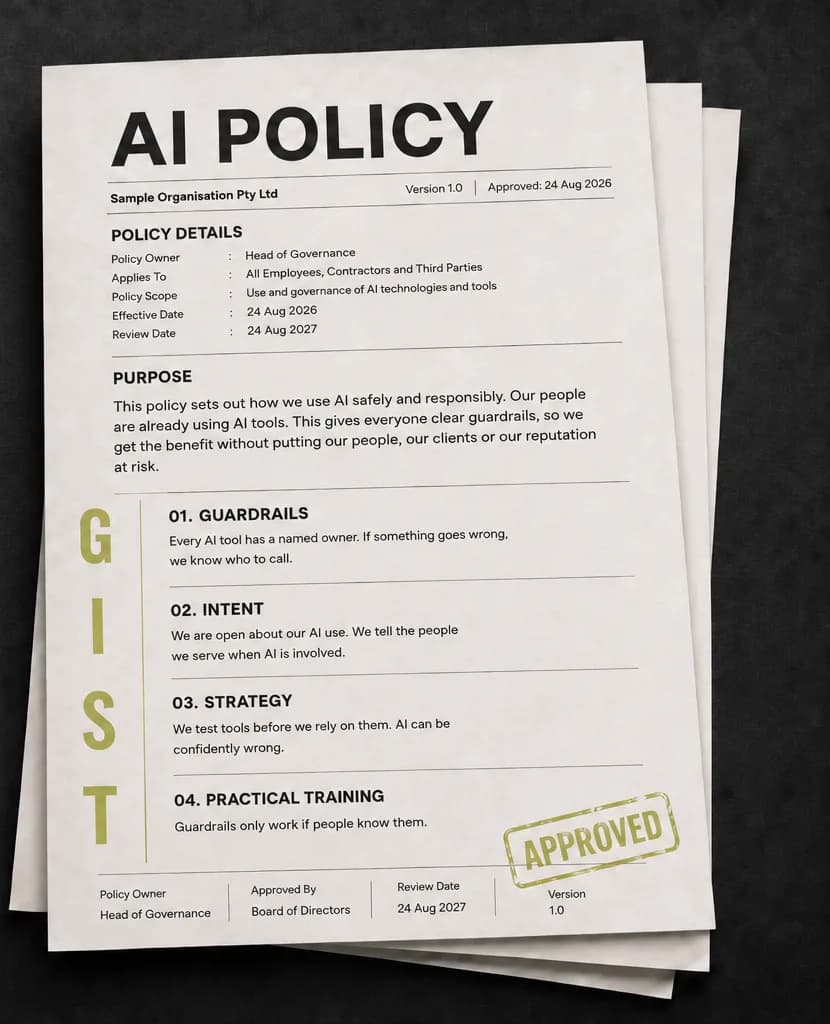
What you download
- Policy details
- Purpose
- Guardrails, our boundaries
- Intent, why we use AI
- Strategy, how AI is used
- Practical Training, bringing our people with us
- If this policy is breached
- Review
- Sign-off
The four in the middle are the GIST AI Framework, and that order is deliberate. Guardrails before intent. Intent before strategy. Training last, because there is no sense training people on rules nobody has written down yet.
Questions people ask
Before you build.
What is an AI policy?
A short document that sets out who may use AI in your organisation, what they may use it on, what information must never go into it and who answers when something goes wrong. One to two pages. Written so the people it applies to will actually read it.
Does a small business need an AI policy?
Yes, and it is shorter than you think. The questions do not change with headcount. Who may use it, on what, with what information and who answers for it. A sole operator pasting a client’s details into a chatbot has the same problem as a bank, with none of the legal team down the hall.
Is this an AI policy template?
It gives you what a template gives you, without the blank page. A template hands you a document to fill in yourself. This asks you the questions a policy needs answered, then writes the finished policy around your answers. You download the finished policy as a PDF and as an editable Word document, ready to take to your board.
Is the AI Policy Builder free?
Yes. Build your policy, download it, and use it. No cost, no catch.
Is this legal advice?
No. It is a general starting point for Australian organisations, written to sit under the Guidance for AI Adoption published by the National AI Centre on 21 October 2025. Laws and guidance change, so get advice suited to your own circumstances before you rely on it.
Can I change the policy after I build it?
Yes. Download the Word version and edit it like any other document, wording, headings, the lot. Both formats come out of the same answers, so the PDF is the copy you table and the Word file is the copy you adjust first. You can also run the builder again with new answers.
Which organisations is it for?
Any Australian organisation. Pick your type at the start, small business, mid-size organisation, not-for-profit or member association, and the policy adjusts the guidance and the tier call-out to suit.
Do you store what I type in?
Your policy answers are used to build the PDF and are not stored. We keep your name and email so we can send you the occasional practical AI note for Australian organisations. Unsubscribe anytime.