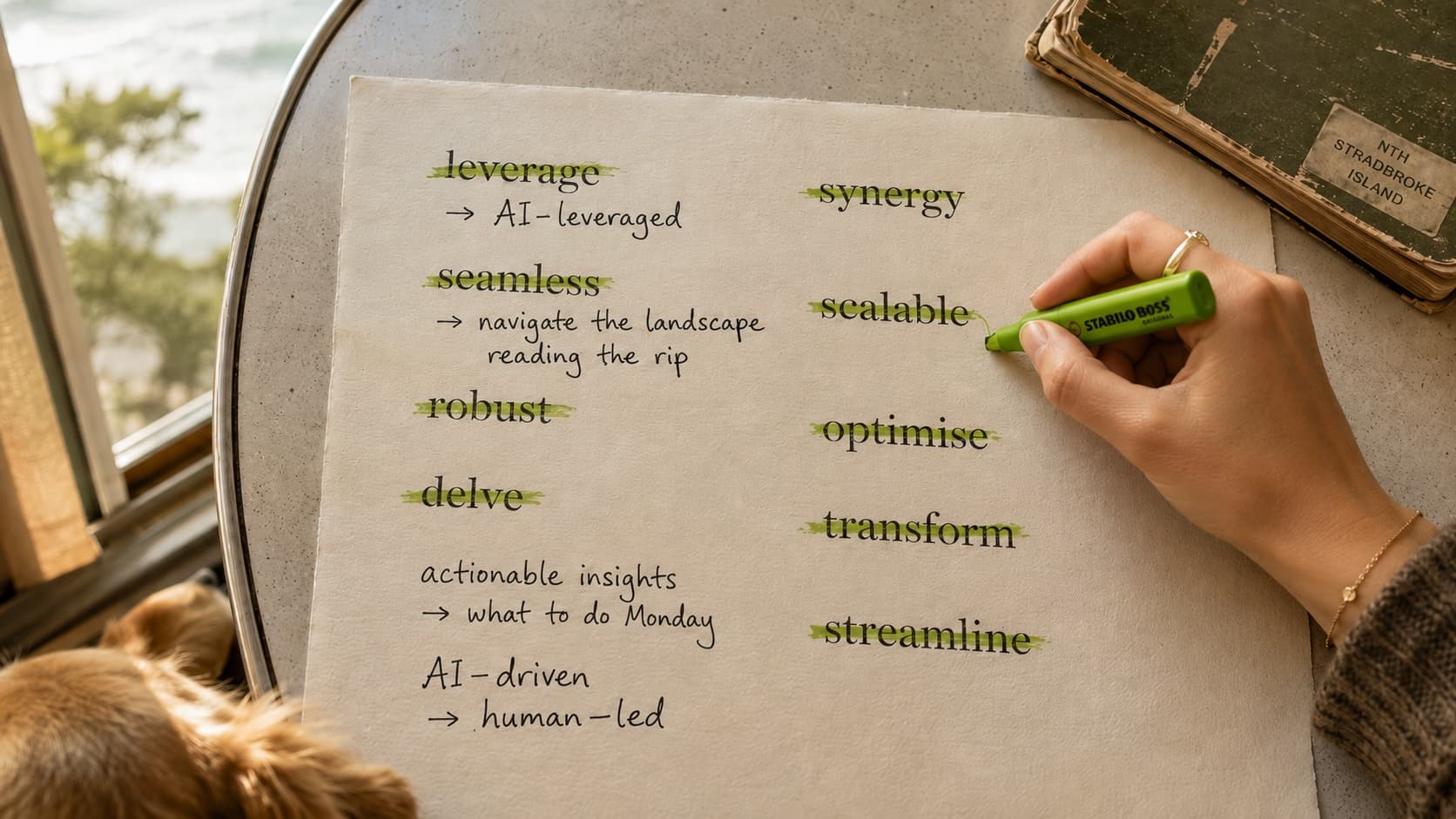
The AI words everyone learned to spot in 2024, like delve and tapestry, are fading. The 2026 tells are smaller and sneakier: words like quietly, dependable and clearer, phrases like “this matters”, and contrast hinges like “not just X, but Y”. And the em dash isn’t a giveaway any more.
If you’ve been scrubbing your drafts against an old list, your AI has moved on without you.
The short version
- Fading: delve, tapestry, the em dash.
- Rising: quietly, dependable, clearer, steady, “this matters”, “why X matters”, “looking ahead”, “rather than simply”.
- Still the biggest giveaway: the patterns. “Not just X, but Y.” “It’s not X, it’s Y.” A neat recap at the end.
- Get the list: download the 2026 cheat sheet
What happened to delve?
It got famous, so it got fixed. A Washington Post analysis found that “delve” has largely faded, replaced by new favourites like “core” and “modern” (opens in a new tab).
Keep it on your list anyway. Older tools and older templates still use it, and your readers learned to spot it.
The new words AI can’t stop using
In October 2026, Graphite, a San Francisco marketing firm, compared the writing of Anthropic’s newest Claude model with human writing (opens in a new tab). These are some of the words and phrases it used far more often than people do.
| Word or phrase | How much more often than humans |
|---|---|
| “this matters” | 116 times |
| “is more than a __, it…” | 98 times |
| “why __ matters” | 92 times |
| “looking ahead, the…” | 40 times |
| “rather than simply” | 32 times |
| “adds another layer” | 27 times |
| “what comes next” | 24 times |
| dependable | 23 times |
| clearer | 14 times |
| matters | 13 times |
| quietly, practical, steady | 11 times each |
| “in practice” | 7 times |
Source: Graphite study of Claude Opus 5.5, reported by Inc., October 2026 (opens in a new tab).
One catch: Graphite tested one model. Graphite’s earlier study found 65% of tells are unique to a single model family (opens in a new tab). ChatGPT, Claude, Copilot and Gemini each have their own habits. So build your own list from your own drafts as well.
The patterns give it away faster than the words
Swap out a word and the sentence can still smell like a robot wrote it. Readers notice shapes before they notice vocabulary.
- The contrast hinge. “It’s not X, it’s Y.” “Not just X, but Y.” “Less about X, more about Y.” A Washington Post analysis of 328,744 ChatGPT messages (opens in a new tab) found “not just X, but Y” in 6% of chats.
- “Not only… but also”. Readers call it out often, according to a Search Engine Land analysis reported by PRSA in April 2026 (opens in a new tab).
- The warm-up and the wrap-up. “In this article, we’ll explore…” at the top. “In conclusion” at the bottom, followed by a recap of everything you just read.
- Sentences that start with “This” or “That”. “This shows…” “This means…” Once you see it, you can’t unsee it.
- The false balance. “While X is true, Y is also important.” “Whether you’re a beginner or an expert…” Safe, and says nothing.
- The metronome. Every paragraph the same length. Every sentence the same shape. Real writing has short bits. And longer ones that wander a little before they land.
Is the em dash still a sign of AI?
Not any more. In Graphite’s October study, Claude’s newest model used em dashes 99% less than the model before it, and OpenAI’s newest used them 95% less than GPT-5 (opens in a new tab). Both now use fewer than the human writers they were compared with.
So if you’re still hunting for em dashes to catch AI, you’re looking in the wrong place. I don’t use them in my own writing, but that’s house style, not detection.
Hang on, “practical” is on the list?
Awkward, given my whole business is Practical AI.
Here’s how I handle it. Names stay. Practical AI and Practical Training are what I call my work, so they keep their place. The lazy version goes: “a practical approach”, “practical steps”, “practical insights”. If a sentence works without the word, cut it.
Do the same with your own brand language. Your list should never strip out the words that are yours.
Will avoiding these words stop AI detection?
No. Detectors look at far more than vocabulary, and so do people. Even the AI detection companies say it: lists of words to avoid won’t get you a clean score on their own (opens in a new tab).
So write to sound like you. Use AI for the first draft. Then make it yours.
What to do on Monday morning
- Update your banned list. Add the 2026 words and patterns above, or grab my full list of AI words to avoid.
- Paste the 2026 add-on below into your AI tool’s custom instructions, under your existing list.
- Read your next draft out loud. If every sentence has the same beat, break a few.
- Cut the last paragraph. If it only recaps, your reader doesn’t need it. End on something real.
The 2026 add-on: paste this under your existing list
Get the 2026 cheat sheet
The full list on two pages: the classic words, the 2026 additions, the patterns and the paste-in prompt. Stick it next to your screen or upload it to your AI tool.
Questions people ask
What are the most common AI writing tells in 2026?
Words like quietly, dependable, clearer and steady, phrases like "this matters" and "looking ahead", and contrast patterns like "not just X, but Y". The patterns are a bigger giveaway than any single word.
Is the em dash a sign of AI writing?
Not any more. The newest Claude and ChatGPT models use far fewer em dashes than they used to, and fewer than many human writers.
Is "delve" still an AI word?
It’s fading. Newer models use it much less, but readers still associate it with AI, so it’s worth cutting.
Do different AI tools have different tells?
Yes. Graphite found most tells belong to a single model family, so ChatGPT, Claude, Copilot and Gemini each have their own habits.
Will avoiding these words stop my writing being flagged as AI?
No. Detectors and readers look at rhythm and structure too. Avoid the words to sound more like you, not to beat a detector.
Sources and further reading
- Inc.: Wondering if AI wrote that document? These are the surprising new clues (opens in a new tab) (Graphite study, October 2026)
- Graphite: AI Tells: Opus 5.5 Update (opens in a new tab) (the study itself, 1 October 2026)
- The Washington Post: What are the clues that ChatGPT wrote something? We analyzed its style (opens in a new tab) (November 2025)
- PRSA: Which signs of AI writing disengage people most? (opens in a new tab) (April 2026)
- Winston AI: Most common ChatGPT words (opens in a new tab)
Ada, my AI assistant, did the research and the first draft. Then I scrubbed it against this very list. Human-led. AI-leveraged. How I work with AI